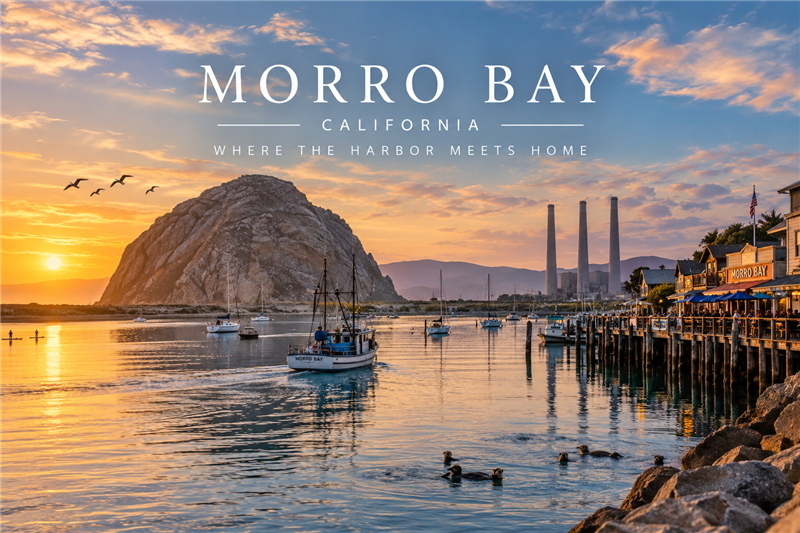
MORRO BAY, CALIFORNIA
Old-School Beach Town. Forward-Thinking Coast.
Morro Bay has managed to hold onto something increasingly rare along the California coast.
It still feels like a real beach town.
Morro Rock rises 576 feet above the harbor — the final and most visible peak in an ancient chain of nine volcanic plugs stretching toward San Luis Obispo known as the Nine Sisters. Formed roughly 23 million years ago, the Rock has watched this coastline change for a very long time.
And then, standing unmistakably beside it, are three towering smokestacks from Morro Bay's former power plant.
Together, they've created a skyline so recognizable that locals have long summed it up simply as:
Three Stacks and a Rock.
Below them, fishing boats head out before sunrise. Surfers make their way toward the waves. Sea otters float between the docks. Kayaks and paddleboards move through the protected bay, and whale-watching boats leave the Embarcadero in search of gray, humpback and blue whales, dolphins and other marine life traveling along this stretch of the Pacific.
Along the Embarcadero, seafood restaurants, galleries, local shops and working harbor life all share the waterfront.
There's something wonderfully old-school about Morro Bay.
But it isn't stuck in the past.
The community continues to have big conversations about what its waterfront should become, how the coastline should be protected and what pieces of Morro Bay's history should follow it into the future. The City is currently updating its Waterfront Master Plan, with completion targeted for late 2026.
Even those famous three stacks are part of that conversation.
The power plant shut down in 2014, and plans associated with the former site have proposed eventually removing the power plant building and stacks. Environmental documents also identify regulated materials, including asbestos-containing components, that would require controlled remediation before demolition.
Some people see three obsolete industrial structures.
Others see a piece of the skyline they've known their entire lives.
That tension between preserving Morro Bay's character and imagining what comes next is part of what makes this town so interesting.
And beyond the waterfront, Morro Bay becomes a collection of neighborhoods with surprisingly different personalities.
Downtown keeps you close to the everyday heart of town. The Embarcadero puts the harbor at the center of life. Morro Heights climbs above it all. The Cloisters offers a quieter planned neighborhood beside open space and the coast. And farther north, the Beach Tract has that classic California feeling where residential streets lead toward the sand.
Same little beach town. Completely different ways to call it home.
EXPLORE MORRO BAY NEIGHBORHOODS
Downtown Morro Bay
Where the beach town becomes your hometown.
Downtown Morro Bay has that slightly weathered, wonderfully familiar feeling that makes an old California beach town so lovable.
Local restaurants, coffee shops and small businesses mix with older storefronts, newer businesses and residential streets, while the harbor and Embarcadero sit just downhill.
Living here puts you close to the everyday rhythm of town.
You can walk for coffee in the morning, head toward the waterfront for dinner, wander through downtown shops or make your way toward the harbor simply because the fog lifted and the afternoon suddenly turned beautiful.
And once you move away from the main streets, downtown becomes surprisingly residential.
Homes are varied — coastal cottages, mid-century houses, remodeled properties, condos and newer residences can all appear within the same general area.
That's part of Morro Bay's charm.
It doesn't all match. It wasn't designed all at once. It grew into the town it is today.
Why buyers love it:
Walkability • local restaurants & coffee • close to the Embarcadero • established homes • small-town character • everyday conveniences • Morro Rock nearby
The vibe:
Old California beach-town character, with everyday life happening right in the middle of it.
The Embarcadero
Where the harbor is part of everyday life.
The Embarcadero is the unmistakable heart of Morro Bay's waterfront.
Fishing boats come and go. Sea otters float between docks. Kayakers and paddleboarders move through the harbor. Restaurants overlook the water, locally owned shops and galleries line the waterfront, and Morro Rock rises beyond it all.
Then there are the boats heading farther out.
Whale watching is a genuine part of Morro Bay life. Tours depart from the Embarcadero, with different species moving through these waters throughout the year — including gray whales in winter and early spring and humpback and blue whales during portions of the warmer months.
It's easy to think of the Embarcadero as somewhere tourists go.
But when Morro Bay is home, you get the waterfront in all the moments between the visitors.
Early mornings when the harbor is quiet.
Fishing boats returning.
Fog lifting from the Rock.
A weeknight dinner beside the water.
An evening walk after the crowds have thinned and the whole harbor seems to settle down.
Residential opportunities directly along the Embarcadero are different and more limited than in Morro Bay's traditional neighborhoods, so the individual property's zoning, permitted use and characteristics become especially important for buyers.
Why buyers love it:
Harbor lifestyle • waterfront views • whale watching • boating & paddling • restaurants & shops • walkability • Morro Rock • marine life
The vibe:
Fishing boats, whale watching, sea otters and salt air — the soul of Morro Bay along the water.
The Cloisters
A quieter neighborhood beside the Pacific.
The Cloisters offers a completely different version of Morro Bay.
Set on the northern side of town near the beach, this planned residential neighborhood feels quieter and more cohesive than many of Morro Bay's older, more eclectic streets.
And open space isn't just nearby.
It's part of the neighborhood.
The original Cloisters subdivision included 124 lots, with 120 designated for single-family residences and roughly 34 acres dedicated to park and open space, including natural lands, wetlands, a pond, neighborhood recreation areas and landscaping.
That planning gives The Cloisters a noticeably different feel.
Walking paths, green areas and the nearby coastline create breathing room, while the residential streets feel comfortably removed from the activity of downtown and the Embarcadero.
And yet you're still unmistakably in Morro Bay.
The beach is nearby. Morro Rock is just down the coast. Downtown is only a short drive away.
For buyers who love Morro Bay's personality but want a more thoughtfully planned and peaceful residential setting, The Cloisters can be a really special balance.
Why buyers love it:
Beach proximity • generous open space • walking paths • planned neighborhood • quieter residential streets • coastal setting • close to town
The vibe:
A peaceful little pocket where neighborhood life, open space and the Pacific come together.
Morro Heights
Above the harbor, overlooking it all.
Follow Morro Bay away from the waterfront and eventually the town begins to climb.
The streets grow quieter.
The activity below starts to disappear.
And the views begin to open.
That's Morro Heights.
This established hillside neighborhood offers a more residential side of Morro Bay while keeping downtown and the harbor remarkably close. Morro Heights is also specifically recognized by the City as one of Morro Bay's scenic resources.
Depending on the property's elevation and orientation, homes can capture beautiful outlooks toward Morro Rock, the harbor, surrounding hills and the Pacific.
But this is one of those neighborhoods where you really need to experience the individual street.
A few houses can change the view. One side of a street may receive different light than the other. Elevation can affect privacy, wind and how connected a home feels to the coastline below.
For buyers, that means the right house isn't only about the house.
It's about where that house sits on the hill.
Why buyers love it:
Elevation • Morro Rock views from some properties • harbor & ocean vistas • quieter streets • established homes • close to downtown
The vibe:
A quieter perch above town, with Morro Bay unfolding below.
Beach Tract
Where neighborhood streets lead to the sand.
Head north from downtown and Morro Bay begins to leave the harbor behind.
Here, life feels increasingly connected to the open Pacific.
The Beach Tract sits west of Highway 1, north of The Cloisters, and is predominantly a single-family residential neighborhood with abundant beach access. The City's plan specifically recognizes maintaining its low-scale beach-neighborhood character and protecting ocean views.
And you can feel that relationship with the beach.
Surfboards lean against houses. Wetsuits dry outside. Neighbors head toward the sand with dogs, kids or coffee in hand.
There's an easygoing quality to it.
Homes range from older coastal residences to remodeled properties, giving the neighborhood some of the eclectic character that makes Morro Bay feel like Morro Bay.
For buyers who have always pictured California coastal living as being able to leave the neighborhood and find the Pacific waiting nearby, this is the part of town that can make that dream feel surprisingly real.
Why buyers love it:
Beach access • surfing • coastal walks • residential streets • ocean views from some properties • relaxed atmosphere • Pacific sunsets
The vibe:
Surfboards, sandy feet and the Pacific at the end of the street.
WHAT TO KNOW BEFORE BUYING IN MORRO BAY
Morro Bay isn't particularly large.
But a few streets can completely change what living here feels like.
The Marine Layer Is Part of the Personality
Fog isn't just weather in Morro Bay.
Some mornings it wraps around Morro Rock until you can barely see it.
Other days it burns away into one of those impossibly clear Central Coast afternoons.
Your relationship with fog, wind and afternoon sunshine can change depending on where a property sits.
If you're seriously considering a home, visit the neighborhood more than once — and preferably at different times of day.
Elevation & Orientation Matter
Especially in Morro Heights and other elevated areas, pay attention to more than the view.
Orientation can affect natural light, wind, privacy and the way outdoor spaces feel throughout the day.
Two homes only a few streets apart can have very different relationships with the coastline.
Salt Air Comes With the Territory
Living this close to the Pacific means the coastal environment becomes part of homeownership.
Exterior materials, windows, decks, railings, roofing and other exposed areas deserve attention when evaluating a property.
The closer you get to the water, the more important ongoing coastal maintenance can become.
Waterfront Properties Deserve Extra Due Diligence
Properties around the harbor and Embarcadero can be very different from a traditional residential home elsewhere in Morro Bay.
Zoning, permitted uses, parking, insurance and property type should all be understood before making assumptions about how a property can be used. Properties throughout Morro Bay are governed by the City's General Plan/Local Coastal Plan and zoning regulations, with additional planning documents applying in certain areas.
Highway 1 Can Matter More Than It Looks on a Map
Highway 1 runs directly through Morro Bay.
A home can look incredibly close to the beach or another part of town online while having a very different relationship with traffic, access and noise once you're standing there.
A Morro Rock View Is Worth Investigating
It's hard not to fall in love with a house when Morro Rock is framed in the window.
If that view is an important part of your decision, understand what sits between the property and it.
Trees grow. Vegetation changes. Neighboring properties evolve.
The view deserves due diligence too.
LIFE IN MORRO BAY
Morro Bay is the kind of town where the Pacific has a way of inserting itself into everyday plans.
You might head down to the Embarcadero for coffee and end up watching otters in the harbor.
Walk toward Morro Rock and stop because someone spotted dolphins offshore.
Take visiting family whale watching and suddenly remember that people travel from all over to experience what's sitting right outside your hometown.
There are fishing boats coming and going, surfers checking the waves, kayakers crossing the harbor and sailboats moving quietly across the water.
But underneath all of that is something harder to describe.
Morro Bay still has that old-school California beach-town soul.
Independent businesses.
Older cottages.
Longtime locals.
Restaurants that have become family traditions.
A waterfront that still feels like a real harbor rather than something designed to imitate one.
And that unmistakable skyline.
Three Stacks and a Rock.
The Rock has been here for millions of years.
The stacks belong to a much more recent chapter of Morro Bay's history — and what happens to them next remains part of a larger conversation about the city's future. Current redevelopment proposals for the former power-plant site include their removal, with environmental remediation required before demolition.
Some locals would be happy to see them go.
Others can't imagine the Morro Bay skyline without them.
And in a funny way, that conversation says a lot about this town.
Morro Bay cares deeply about where it came from, while continuing to ask what it wants to become.
It's old-school without standing still.
And maybe that's the sweet spot.
A FEW MORRO BAY FAVORITES
Morro Rock & the Nine Sisters
You really can't talk about Morro Bay without talking about the Rock.
Morro Rock formed roughly 23 million years ago and is the last and most visible of the Nine Sisters, the chain of ancient volcanic plugs stretching between San Luis Obispo and Morro Bay. At approximately 576 feet tall, it became an important navigational landmark for mariners and is now a California Historical Landmark and protected bird sanctuary.
But facts don't really explain what the Rock means when you live here.
It's simply how you know where you are.
You see it through the fog on the way into town. From neighborhood windows. Across the harbor. Behind fishing boats. From the beach with surfers in the foreground.
Sometimes it disappears completely into the marine layer and then suddenly reappears.
Visitors come to Morro Bay to see the Rock. Locals get to have it at the end of town.
The Embarcadero
The heart of Morro Bay's waterfront.
Fishing boats, seafood restaurants, galleries, local shops, kayakers, paddleboarders, sea otters and harbor life all unfold along the same stretch of water beneath Morro Rock.
Whale Watching & Life Offshore
The harbor is only the beginning.
Whale-watching boats depart from the Embarcadero, and different seasons can bring gray, humpback and blue whales through the waters off Morro Bay, along with dolphins and other marine life.
It's one of those experiences that reminds you how wild this coastline still is.
Three Stacks & a Rock
For generations, Morro Bay's skyline hasn't been defined by one landmark.
It's been defined by four.
The three towering stacks of the former Morro Bay Power Plant stand beside ancient Morro Rock, creating the silhouette locals know as Three Stacks and a Rock.
The power plant closed in 2014, and the stacks no longer serve their original purpose. Current plans associated with redevelopment of the site contemplate their demolition, but doing so isn't as simple as knocking them down. Environmental documentation identifies regulated materials within the former plant, including asbestos-containing components, that would need to be properly removed and disposed of as part of remediation.
And then there's the emotional question:
Should they come down at all?
To some people they're remnants of an industrial past.
To others they're history — part of the skyline, artwork, memories and visual identity of Morro Bay.
Whatever ultimately happens, they represent something very Morro Bay:
a community deciding which pieces of its past belong in its future.
Morro Strand State Beach
A long stretch of open coastline north of Morro Rock where surfing, beach walks and evenings beside the Pacific can become part of the weekly routine.
The Harbor
Paddle it. Boat it. Fish it. Walk beside it.
Or grab something to eat and spend an embarrassing amount of time watching sea otters.
Nobody's judging.
Black Hill & the Surrounding Trails
Morro Bay isn't only beautiful from the water.
Head into the surrounding hills and suddenly the harbor, Rock, sandspit and coastline stretch out beneath you.
THINKING ABOUT BUYING IN MORRO BAY?
Morro Bay isn't a community I'd recommend choosing from listing photos alone.
You have to experience the different versions of it.
Walk downtown in the morning.
Spend an afternoon along the Embarcadero.
Stand beneath Morro Rock and look back toward those three stacks that have defined the skyline for generations.
Drive into Morro Heights and watch the perspective change as you climb.
Walk through The Cloisters toward the coast.
Head into the Beach Tract and follow one of those neighborhood streets toward the Pacific.
Then do it all again when the fog rolls in.
Because finding a home in Morro Bay isn't simply about deciding that you want to live near the ocean.
It's about figuring out how you want the ocean — and this wonderfully unusual little town — to fit into your everyday life.
Maybe that's watching fishing boats return to the harbor.
Maybe it's seeing Morro Rock from your window.
Maybe it's carrying a surfboard down the street.
Maybe it's walking the Embarcadero on a Tuesday night, spotting an otter below you and remembering that this is just where you live now.
Or maybe it's simply knowing you've found one of those increasingly rare California beach towns that still feels like itself.
Old-school, a little quirky, deeply connected to the Pacific — and still deciding what it wants its next chapter to be.
Whether you're looking for a beach cottage, a hillside home with a view, a quieter neighborhood near the coast or simply your own little piece of Morro Bay, I'm happy to help you explore it —
neighborhood by neighborhood, street by street, until you find the little corner that feels like yours.
EXPLORE MORRO BAY PROPERTIES →